
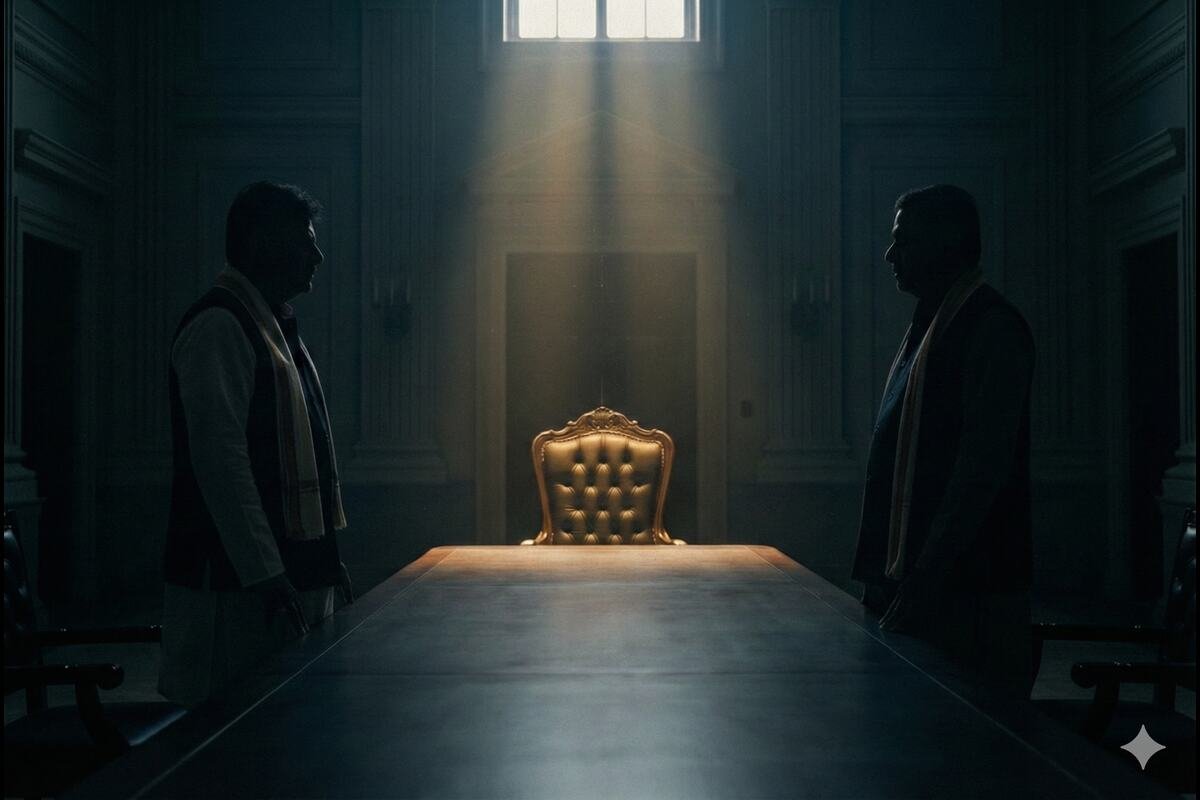
There are many kinds of leaders.
The visionary.
The operator.
The communicator.
The firefighter.
But the most dangerous one — in any organisation — is the leader who can’t let go.
Because when leaders fear being replaced, they don’t protect the organisation.
They protect themselves.
And that, more than any competitor, is what destroys systems from the inside.
This isn’t about politics or parties.
This is about leadership behaviour.
The kind you see in companies, startups, agencies, family businesses — and yes, in governments too.
And if you’ve been watching Karnataka over the last 48 hours, you’ve seen exactly what I’m talking about.
When Wordplay Becomes Power-Play
Two posts.
Two leaders.
Two very different signals.
A cryptic line here: “WORD POWER IS WORLD POWER.”
A firm, assertive line there — signalling continuity, tenure, and a full-term intent.
On the surface, it looks like harmless messaging.
But anyone who has seen leadership up close knows this:
Symbolism is the first sign that conversation has stopped,
and negotiation has shifted from rooms to signals.
The real problem is not the posts.
It is what the posts represent — uncertainty at the top, insecurity leaking sideways, and ambition making itself visible.
Any organisation becomes fragile the moment its top two leaders stop speaking the same language.
The Psychology of Leaders Who Can’t Let Go
Leaders who can’t let go don’t behave badly because they’re bad people.
They behave badly because they’re afraid:
- Afraid of being forgotten.
- Afraid of losing relevance.
- Afraid someone younger will outperform them.
- Afraid the system will run just fine without them.
- Afraid that their power was borrowed, not earned.
So they hoard decisions.
They centralise control.
They delay succession.
They promote loyalists, not talent.
They hold on even when holding on is hurting everyone.
And they start seeing successors not as continuity…
but as competition.
Every fragile organisation has one thing in common:
the top leadership doesn’t groom the next line — it suffocates it.
What Happens When Leaders Hold On Too Long
The collapse doesn’t happen overnight.
It happens slowly, quietly, predictably.
- Talent leaves
- The organisation stalls
- Decision-making slows
- Internal factions grow
- Public trust drops
- The brand weakens
- The mission loses direction
- And everything becomes about “who” instead of “what”
By the time the crisis becomes visible, the damage was done months earlier — in silences, in delays, in signals.
Power vacuums are never accidents.
They are created by leaders who refused to share space.
Karnataka Is Not the Issue. The Leadership Pattern Is.
What we’re witnessing in Karnataka right now is not unique.
It happens everywhere:
- In startups where the founder refuses to step aside.
- In family businesses where succession is a taboo topic.
- In corporates where leaders cling to chairs till chairs collapse.
- In agencies where the top boss hoards every decision.
- In political parties where growth is seen as threat, not strength.
This is not about BJP or Congress.
It’s not about who deserves what chair.
This is about what insecure leadership does to any system.
When leaders silently fight each other, the organisation fights for survival.
When leaders clutch for control, the organisation loses control.
**Leaders Who Let Go Build Legacies.
Leaders Who Hold On Build Cemeteries.**
Strong leaders don’t fear succession.
They prepare for it.
They build structures, not dependencies.
They build teams, not echo chambers.
They build clarity, not confusion.
They build organisations that outlive them.
Weak leaders do the opposite.
They want to be indispensable.
They want to be the only voice in the room.
They want every spotlight, every credit, every narrative.
The irony?
When they finally fall, the organisation falls with them — because they never allowed a second line to rise.
What the Karnataka Moment Teaches Us — If We’re Willing to See It
Every power tussle, every internal rift, every public signal is a leadership lesson:
- If leadership is confused internally, it will be punished externally.
- If succession is unclear, factions will fill the void.
- If leaders don’t talk privately, they will signal publicly.
- If clarity doesn’t exist at the top, stability won’t exist below.
And the most important lesson?
When the top two leaders of any organisation stop rowing together,
the organisation stops moving altogether.
**Letting Go Isn’t Weakness.
Holding On Is.**
Great leadership isn’t proven by holding on till the last day.
It’s proven by stepping back at the right time — with dignity, with confidence, with clarity.
Control is not leadership.
Continuity is.
Succession does not weaken a system.
It strengthens it.
And whether it’s a state government, a corporation, a political party, or a startup — the truth remains the same:
Leaders who can’t let go don’t just lose power.
They make everyone else lose trust.
No pitch.
No prediction.
Just perspective — from someone who’s watched enough leadership battles to know how they all end.