A few weeks ago, something started bothering me.
Not because of one protest.
Not because of one political party.
Not because of one government.
Because everywhere I looked…
…people I knew were sharing completely different versions of the same event.
A friend’s Instagram Story.
A colleague’s LinkedIn post.
A relative’s WhatsApp Status.
A reel.
A tweet.
A YouTube video.
Every platform seemed to have its own version of reality.
The strange part wasn’t that people disagreed.
People have always disagreed.
The strange part was that every single person sounded completely convinced they were right.
And then I noticed something else.
Almost everyone around me had chosen a side.
I hadn’t.
Not because I didn’t care.
And not because I was trying to stay neutral.
I simply wasn’t ready to form an opinion.
So, unlike many of the conversations unfolding around me, I did something unusual.
I didn’t share a single reel.
I didn’t repost a single Story.
I didn’t write a LinkedIn post.
I didn’t update my WhatsApp Status.
I didn’t tell people what to think.
I watched.
I listened.
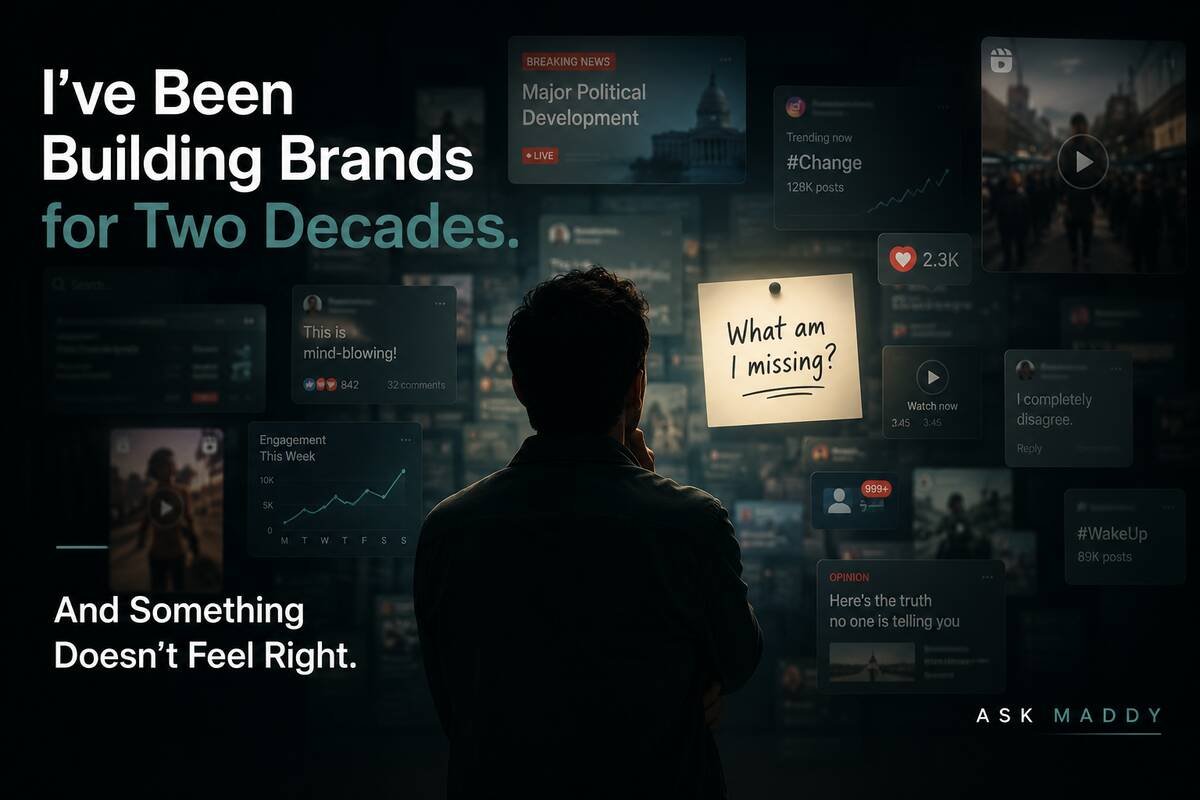
And I kept asking myself one question.
What am I missing?
That question stayed with me for days.
Because the more I observed…
…the less certain I became.
How could intelligent people I know, people I respect, people I know are capable of critical thinking, end up believing completely different versions of the same event?
They couldn’t all be right.
But they couldn’t all be irrational either.
Somewhere between the event itself…
…and the opinions filling our screens…
…something else was happening.
I couldn’t explain it.
But I couldn’t ignore it either.
And then I realised something.
For more than twenty years, I’ve helped businesses solve a very similar problem.
How do you earn attention?
Why do some stories spread while others disappear?
Why do people trust one message but ignore another?
How does an ordinary idea become impossible to ignore?
I’ve spent two decades helping brands understand attention.
Yet I had never stopped to ask a much more personal question.
Who was earning mine?
That was the moment I opened a blank document.
Not because I wanted to write about politics.
Not because I wanted to defend one side or criticise another.
But because I wanted to understand something much bigger.
Had the way we consume information quietly changed… while most of us weren’t paying attention?
I Started Looking at the Internet Differently
For the next few days, I did something I hadn’t consciously done before.
I stopped reacting.
I started observing.
Whenever I opened Instagram, LinkedIn, X, or YouTube, I wasn’t just looking at the content anymore.
I was looking at the patterns.
Why was this particular reel suddenly everywhere?
Why were so many people sharing the same clip?
Why had this become today’s conversation, while yesterday’s outrage had completely disappeared?
The content itself was no longer the most interesting part.
The journey it had taken to reach me was.
That surprised me.
Because until then, I had always assumed I consumed information the same way everyone else did.
Read.
Watch.
Think.
Move on.
But twenty years of helping businesses build brands had quietly trained my mind to notice something else.
Not just what people were saying.
But how it was spreading.
Every successful brand I’ve worked with had one thing in common.
They didn’t simply have a good product.
They had a story people wanted to repeat.
A story people felt compelled to share.
A story that travelled.
And suddenly, I realised the internet wasn’t all that different.
Ideas travel.
Opinions travel.
Fear travels.
Hope travels.
Outrage travels.
Sometimes faster than facts.
Sometimes slower than truth.
But they all travel.
That’s when I stopped asking,
“Do I agree with this?”
And started asking,
“Why am I seeing this today?”
That single question changed the way I looked at almost everything online.
Because once you stop looking only at the message…
…you begin noticing the machinery around it.
You notice timing.
You notice repetition.
You notice how different creators start talking about the same issue at roughly the same time.
You notice how some stories disappear almost overnight, while others seem impossible to escape.
None of those observations prove anything.
And that’s important.
Patterns are not evidence.
But they are often the beginning of better questions.
I realised that my job had never really been about marketing.
It had been about understanding attention.
Why people notice one thing and ignore another.
Why one story spreads while another quietly disappears.
Why one message earns trust while another struggles to be heard.
For twenty years, I’d been helping brands answer those questions.
I had just never turned those same questions towards the information I consumed every day.
And once I did…
I found it almost impossible to go back.
Why this moment mattered
This wasn’t about becoming suspicious of everything.
It wasn’t about assuming that every viral post was manipulated.
Or that every movement had hidden intentions.
It was much simpler than that.
I realised I had spent years asking one question as a marketer—
“How do people earn attention?”
But almost never asked myself the same question as a citizen—
“Why has this earned mine?”
That single shift didn’t give me answers.
If anything, it left me with more questions than before.
But they were better questions.
And over time, I realised they were the only questions worth starting with.
We Were Looking at the Same Event. But Not Seeing the Same Thing.
The more I observed…
…the more one thought refused to leave me alone.
What if we weren’t actually arguing about the same thing?
At first, that sounds ridiculous.
Of course we were.
The same protest.
The same news.
The same country.
The same event.
But were we really seeing the same event?
Think about it.
One person watches a 30-second reel.
Another reads a newspaper article.
Someone else listens to a podcast.
Another spends an hour watching YouTube videos.
Someone reads comments.
Someone else never does.
By the time all of us form an opinion…
We’ve each consumed completely different pieces of information.
Different creators.
Different headlines.
Different facts.
Different emotions.
Different contexts.
And yet…
We confidently believe we’re discussing the same reality.
That was a strange thought.
Because suddenly, many of the arguments I was seeing online started making sense.
People weren’t necessarily disagreeing because one person was intelligent and the other wasn’t.
Or because one cared more than the other.
They were often disagreeing because they had travelled to completely different conclusions using completely different information.
In other words…
They weren’t standing on opposite sides of the same road.
They were standing on different roads altogether.
That changed something for me.
Until then, I’d assumed that finding the truth simply meant consuming more content.
Now I wasn’t so sure.
Because consuming more content often meant consuming more versions of reality.
Not necessarily getting closer to the truth.
And that’s when another uncomfortable question entered my mind.
If every platform is showing me a slightly different version of the world…
How do I know whether I’m seeing a balanced picture…
…or simply the picture that found me first?
I didn’t have an answer.
I still don’t.
But from that moment onwards…
Whenever I caught myself becoming absolutely certain about something I’d only just learned…
I became suspicious of my own certainty.
Not because certainty is always wrong.
But because I realised how easily confidence can arrive before understanding does.
That, more than anything else, changed the way I consumed information.
I became less interested in finding people who agreed with me.
And more interested in understanding why people I respected had reached completely different conclusions.
Because somewhere in those differences…
…I felt there was something worth learning.
The Questions That Changed Me
Until this point, I had been looking for answers.
Then I realised…
Maybe I was asking the wrong questions.
For years, whenever I came across a major event, my first instinct was probably the same as everyone else’s.
Who is right?
Who is wrong?
Whose side should I be on?
But somewhere along the way…
Those questions stopped helping me.
Instead, a completely different set of questions began to take their place.
Not because someone taught them to me.
Because I couldn’t stop thinking about them.
Why this? Why now?
Every day, thousands of stories compete for our attention.
Most disappear without us ever noticing them.
So whenever one particular event suddenly dominates every platform…
I find myself wondering:
Why this one?
Why today?
Why not last week?
Sometimes the answer is obvious.
Sometimes it’s simply because the issue genuinely matters to millions of people.
Sometimes it’s because social media rewards emotionally charged conversations.
Often, it’s a combination of many things.
I don’t assume one explanation.
I simply stop assuming there is only one.
Who benefits?
This used to sound like a conspiracy question.
Now I think it’s simply a practical one.
Every major event changes something.
It affects people differently.
Students.
Parents.
Businesses.
Media organisations.
Political parties.
Creators.
Platforms.
Some gain attention.
Some gain influence.
Some gain trust.
Some lose it.
The point isn’t to find a villain.
The point is to understand incentives.
Because incentives often explain behaviour far better than opinions do.
What am I not seeing?
This has become my favourite question.
Not because I always find an answer.
But because it reminds me that every feed is incomplete.
Every platform shows me something.
Every platform hides something else.
Not necessarily with bad intent.
Sometimes simply because that’s how algorithms work.
Sometimes because I chose to follow certain people and not others.
Whatever the reason…
I’ve learned to be cautious of any conclusion built on only one stream of information.
Is the conversation still about the original issue?
This question came much later.
And it may have been the one that stayed with me the longest.
I’ve seen campaigns begin with one simple message…
…and evolve into something completely different.
Not because anyone planned it that way.
But because more people joined.
New priorities emerged.
New voices entered.
The conversation grew.
Sometimes that’s exactly what should happen.
Sometimes it’s a sign that society is paying attention.
But I still think it’s worth asking.
Are we discussing the issue that started all of this…
…or the conversation that grew around it?
Those aren’t always the same thing.
What would change my mind?
This is the hardest question I ask myself.
Because it forces me to admit something uncomfortable.
I could be wrong.
If no evidence could ever change my opinion…
Then I probably wasn’t investigating in the first place.
I was defending a position.
And I’ve realised that’s a very different mindset.
I don’t ask these questions because they make me smarter.
Quite the opposite.
I ask them because they remind me how little I actually know.
The older I get…
The less interested I become in having the fastest opinion.
And the more interested I become in asking better questions.
Because I’ve discovered something that twenty years in branding never explicitly taught me…
The quality of our conclusions is usually limited by the quality of our questions.
And once I realised that…
I found myself looking back at everything that had prompted me to write this article in the first place.
Not to decide who was right.
But to understand what had actually changed.
The Moment It Became Bigger Than the Issue
This is where those questions stopped being theoretical.
I found myself watching the conversation around NEET unfold.
Like everyone else, I began with the obvious question.
Were there irregularities?
If there were, students deserved answers.
That part wasn’t difficult.
What caught my attention came later.
As the days passed, the conversation began to expand.
It was no longer only about students.
Or an examination.
Or accountability.
New voices entered.
New narratives emerged.
Every day seemed to introduce a new angle.
Some discussions focused on education.
Others on institutions.
Others on politics.
Others on ideology.
At one point, I paused and asked myself a simple question.
If I opened social media today for the first time, would I even know what the students were originally asking for?
That question stayed with me.
Not because I believed something sinister was happening.
But because I recognised something familiar.
I’d seen this before.
Not in politics.
In branding.
A campaign starts with one message.
As more people join the conversation, new meanings get attached to it.
The conversation grows.
Sometimes that’s exactly what should happen.
Sometimes it helps a cause reach people who would otherwise never have heard about it.
But sometimes…
The conversation becomes so large that the original issue has to compete for attention inside its own movement.
Whether that’s simply how public conversations evolve…
Whether social media accelerates that process…
Or whether something else is at play…
I don’t know.
And I’m deliberately resisting the temptation to pretend that I do.
Because this article isn’t about proving a theory.
It’s about describing a moment.
The moment I realised I had stopped asking,
“Who is right?”
And started asking,
“How did we get here?”
That single question changed the way I look at every major public conversation now.
Before You Decide
I didn’t write this article to tell you what to think.
In fact, if you’ve reached the end hoping I’d tell you which side is right…
I’ve probably disappointed you.
That wasn’t my goal.
My goal was much simpler.
To share something that changed the way I consume information.
Because I have a feeling this won’t be the last public conversation that divides us.
There will be another protest.
Another election.
Another controversy.
Another viral reel.
Another trending hashtag.
Another moment when everyone seems absolutely certain.
When that happens…
I hope I remember the question that started this article.
What am I missing?
Not because that question guarantees the truth.
But because it reminds me that certainty is easy.
Curiosity is harder.
And perhaps…
More valuable.
Don’t ask,
“Which side am I on?”
Ask,
“What am I missing?”
Because the moment we stop asking questions…
…someone else starts answering them for us.