
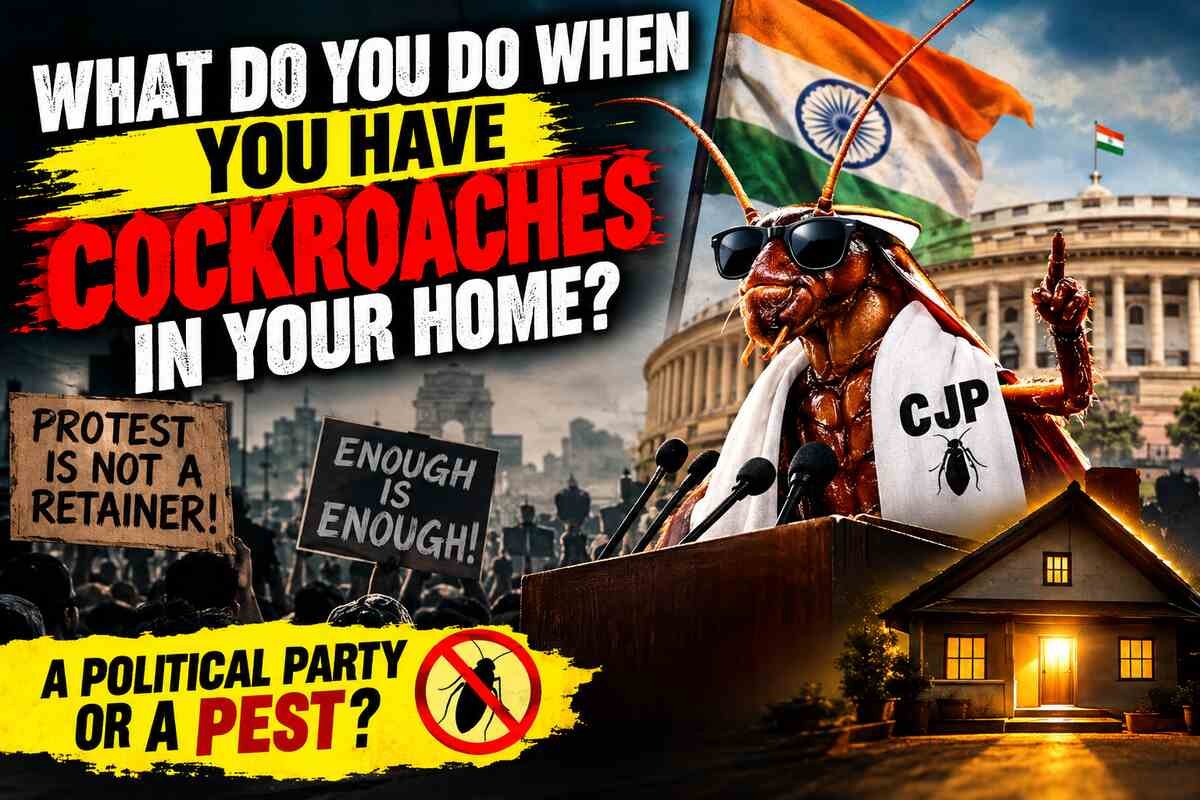
When protest becomes a business model, outrage becomes the product, and the public becomes the hostage.
Let me ask you a simple question.
What do you do when you find cockroaches in your home?
You have three choices. You ignore them. You call pest control. Or you let them multiply until they begin behaving as though the house belongs to them.
No sensible homeowner chooses the third option.
Yet, when it comes to politics, public demonstrations and manufactured outrage, we seem to have developed a strange habit of doing precisely that: giving every spectacle more attention, every provocation a bigger platform, and every confrontation another opportunity to grow.
And then we wonder why the spectacle never ends.
Welcome to the age of the Cockroach Janata Party.
1. A Party, a Protest, and a Very Serious Question
Let us begin with the name itself.
The Cockroach Janata Party. CJP.
Is this a political party? A protest collective? A satirical experiment? A youth movement? Or an attempt to turn a deliberately provocative identity into a national political spectacle?
Whatever its original intention, the name has certainly attracted attention. But attention is not achievement. Publicity is not credibility. And the ability to mobilise a crowd does not automatically establish the legitimacy of every demand that crowd makes.
A serious political movement must be judged by its objectives, its methods, its leadership, its transparency and, ultimately, its contribution to solving the problem it claims to represent.
So let us ask the obvious questions.
What exactly does this party stand for beyond protest? What is its long-term political programme? What measurable outcomes is it seeking? Who makes its decisions? Who finances its activities? What are its sources of funding? And what accountability does it offer to the public whose attention it demands?
These are legitimate questions for any political organisation, particularly one attempting to establish a national presence.
A provocative name may open the door. It cannot substitute for answers.
2. The Second Protest. The Same Story. What Is the Endgame?
Delhi has just witnessed another round of protests, detentions and political confrontation.
The immediate issue has been the demand for the resignation of Chief Election Commissioner Gyanesh Kumar over alleged irregularities in the revision of electoral rolls. These allegations deserve examination through evidence, institutional scrutiny and the appropriate legal processes.
But a legitimate question about electoral integrity does not automatically validate every tactic adopted in its name.
On 10 October 2026, Delhi witnessed extensive police detentions amid attempts to hold demonstrations. On 11 October, three CJP leaders—Abhijeet Dipke, Saurav Das and Ashutosh Ranka—were released after furnishing surety bonds subject to a one-year condition to maintain peace and good behaviour.
The party subsequently announced further protest activity.
That sequence raises questions about strategy, responsibility and the boundaries of lawful protest. It does not, by itself, establish that the leaders have violated their release conditions. But it certainly warrants scrutiny of what the organisers intend to do next and whether their actions will respect the law.
And here is the question I want every citizen to consider:
How many protests does it take before a movement explains, clearly and convincingly, what success looks like?
Is there a defined objective? A process for verifying the allegations? A constitutional mechanism for achieving the desired outcome? A set of conditions under which the agitation will conclude?
Or is the protest itself becoming the objective?
Because if the plan is to return to the streets repeatedly, escalate the rhetoric, demand increasingly dramatic outcomes and keep the cameras rolling, then we have to ask whether the movement has a resolution strategy or merely a mobilisation strategy.
A protest cannot be an endlessly renewable subscription to public disruption.
Protest is not a retainer. Democracy is not a monthly service contract. And the country is not obligated to renew its attention every time a new demonstration is announced.
3. Release Is Not a Political Victory Certificate
When people are detained and subsequently released, there is a temptation for political movements to turn the entire episode into a victory narrative.
The authorities acted. The leaders were released. The movement returned to the headlines. The next demonstration was announced.
But release from preventive detention is not, by itself, proof that every allegation made by the movement is correct. Equally, detention is not proof that every protester is guilty of wrongdoing.
The facts, the applicable law and the actual terms of the release must determine the legal position.
The same standard must apply to everyone.
If the leaders have been required to maintain peace and good behaviour for a year, they should respect that condition. If they believe the authorities have acted unlawfully, they should challenge the action through the appropriate legal channels.
They are free to criticise the Prime Minister. They are free to question the government. They are free to advocate political change within the law.
But freedom of expression does not make every statement wise, every accusation substantiated or every form of confrontation justified.
Calling a political leader a coward may generate headlines. It may energise supporters. It may circulate across social media within minutes.
But what does it actually establish?
Nothing about the accuracy of an allegation. Nothing about the validity of a political demand. Nothing about the quality of a proposed solution.
Insults are not evidence. Slogans are not investigations. And theatrical defiance is not a substitute for a credible political programme.
If the objective is accountability, then produce evidence and pursue accountability. If the objective is electoral reform, explain the reform. If the objective is to change the government, make the case to the electorate.
That is politics.
Everything else risks becoming performance.
4. Who Is Funding the Show? Follow the Evidence.
Now we come to a question that deserves a serious answer.
How is this movement organising itself? Who pays for its travel, accommodation, communication, publicity, legal support and mobilisation? What role do affiliated organisations, political groups, donors and volunteers play?
These are not unreasonable questions. They are standard questions of organisational transparency.
A movement that wants to influence national politics should be prepared to explain its funding and organisational structure to the extent required by law. The public is entitled to distinguish transparent civic mobilisation from undisclosed financial or political influence.
But let us also be precise.
Rapid growth, controversial slogans, opposition support or an ability to mobilise large numbers do not, on their own, prove the existence of a secret sponsor or a coordinated conspiracy.
If there are hidden financial interests, illegal funding arrangements or undisclosed political relationships, investigate them. Follow the money. Examine the records. Establish the facts.
Do not replace evidence with speculation.
The answer to a suspected hidden agenda is not another unsubstantiated allegation. It is transparent, evidence-based investigation.
Who funds the movement? What are the declared sources of support? Are the relevant disclosures being made? Are there financial or organisational relationships that warrant further examination?
Ask the questions. Demand the answers. Publish the evidence.
A democracy that is confident in itself should not fear scrutiny of political organisations. Nor should any organisation claiming to defend democracy fear legitimate scrutiny of its own operations.
Transparency is not an attack on dissent. It is a basic condition of public trust.
5. India Is Not a Stage for Permanent Political Instability
India is the world’s largest democracy. That status carries enormous responsibility.
We have disagreements. We have competing political parties. We have movements that challenge the government. We have institutions that must be questioned when evidence warrants it.
That is part of democracy.
But there is a difference between challenging a government and treating political instability as an achievement in itself.
There is a difference between demanding institutional accountability and undermining public confidence through allegations that have not been substantiated.
And there is a difference between exercising civil liberties and treating confrontation as the only legitimate form of political participation.
Recent developments in countries such as Nepal and Bangladesh have prompted discussion about political instability, mass mobilisation and the vulnerability of institutions. Those countries have their own histories, causes and political circumstances; they should not be reduced to a simplistic comparison with India.
Nevertheless, the broader lesson is worth considering: institutional trust, public order, political accountability and peaceful democratic transitions matter enormously.
India should not be complacent about its institutions. Neither should it romanticise disruption merely because disruption is presented in the language of revolution.
A country of India’s scale and diversity cannot afford to confuse constant confrontation with constant progress.
The answer is not to suppress dissent. It is to ensure that dissent remains peaceful, lawful, accountable and connected to a clearly articulated public purpose.
We must defend the right to question power without pretending that every attempt to destabilise public life is necessarily an act of democratic courage.
6. The Cockroach Test: What Remains When the Noise Stops?
Here is a simple test for the CJP and every other movement that demands the country’s attention.
Switch off the cameras. Remove the slogans. Ignore the provocative branding. Stop counting social media impressions.
Now answer five questions.
- What precisely is the problem you are trying to solve?
- What independently verifiable evidence supports your claims?
- What specific, lawful and practical remedy are you proposing?
- Who is accountable for your decisions, finances and conduct?
- Under what conditions will you consider your objective achieved and conclude the agitation?
These are not hostile questions. They are the minimum questions a responsible citizen should ask of an organisation seeking political influence.
If the answers are coherent, let the movement make its case.
If the evidence supports its allegations, let the appropriate institutions examine them.
If reforms are necessary, pursue them.
But if the answers continually shift, the demands expand without explanation, and the spectacle grows while the proposed solutions remain vague, the public has every right to question whether the movement has lost sight of its original purpose.
The cockroach analogy is about a political spectacle that refuses to respect boundaries. It is not a licence to dehumanise people, suppress peaceful dissent or deny anyone their constitutional rights.
People are entitled to political opinions, even opinions we strongly oppose. Political organisations are entitled to advocate change within the law.
But no organisation is entitled to unquestioning public acceptance.
And no movement deserves permanent attention merely because it has mastered the art of creating controversy.
7. Stop Rewarding the Spectacle
Here is where the public also needs to look in the mirror.
Who gives these movements their visibility?
We do.
Every provocative clip shared without context. Every insult circulated as entertainment. Every unverified allegation repeated as fact. Every confrontation turned into a trending topic.
The outrage economy has an audience, and that audience often helps finance it with its attention.
This does not mean legitimate journalism should ignore a protest or that citizens should stop questioning political movements. On the contrary, journalists must investigate, citizens must scrutinise, and institutions must respond to credible allegations.
But there is a difference between reporting a movement and becoming its publicity department.
There is a difference between examining a controversy and amplifying every provocation.
And there is a difference between holding power accountable and giving a spectacle free, unlimited publicity.
The public must become more discerning.
Demand evidence. Read beyond headlines. Question the organisers. Examine their demands. Check the claims. Ask what practical outcome they are pursuing.
If a movement has a legitimate case, it should survive those questions.
If it cannot, it should not be rescued by outrage alone.
8. Enough Is Enough—But the Response Must Be Democratic
I do not want an India where every disagreement becomes a street confrontation, every political dispute becomes an indefinite agitation, and every demand for accountability is drowned out by a competition over who can shout the loudest.
I want an India where institutions are strong enough to investigate allegations, political organisations are transparent enough to answer questions, governments are accountable enough to correct mistakes, and citizens are informed enough to distinguish evidence from theatre.
That requires consistency.
If we defend peaceful protest when our preferred political side is protesting, we must defend the same right when our opponents protest.
If we demand evidence from the government, we must demand evidence from those accusing the government.
If we expect elected representatives to respect constitutional limits, we must expect political movements to respect the law as well.
There can be no selective democracy.
And there can be no blanket assumption that every protest is a conspiracy, just as there can be no blanket assumption that every protest is noble.
The standard must be the same for everyone: evidence, transparency, legality and accountability.
The CJP must answer questions about its objectives, methods, organisation and funding where appropriate. The government must answer legitimate questions about electoral processes. The Election Commission must address credible evidence through transparent institutional mechanisms. The media must investigate rather than merely amplify.
That is how a democracy protects itself: not by silencing every critic, but by refusing to grant any political actor immunity from scrutiny.
The Final Word: Who Owns the House?
Return to the original question.
What do you do when you have cockroaches in your home?
You identify the problem. You establish its source. You take proportionate, effective action. You protect your home.
You do not burn down the house because you found a pest. You do not abandon the house to it. And you do not mistake its persistence for ownership.
In a democracy, the equivalent is not violence, vigilantism or indiscriminate suppression. It is lawful accountability, institutional scrutiny, informed voting, transparent investigation and the refusal to reward political theatre with unearned legitimacy.
The country belongs to its citizens. No government owns India. No protest movement owns India. No political party owns India.
The right to question the government is real. So is the public’s right to question those doing the questioning.
If the CJP has a legitimate case, let it present the evidence. If it has a credible programme, let it explain the plan. If it claims to speak for the people, let it demonstrate accountability to the people.
And if any movement cannot survive those basic tests, it should not be allowed to survive on spectacle alone.
We do not need to silence every voice. We do not need to agree with every government. We do not need to fear every protest.
We need to stop confusing noise with leadership, provocation with courage, and endless agitation with public service.
The answer is not to kill people or suppress dissent. It is to kill the spectacle with scrutiny, deny misinformation the oxygen of blind amplification, and insist that every political movement earn public trust through evidence and accountability.
Because in the end, the question is not whether a cockroach can make noise in your house.
The question is whether the people who own the house still remember that it is theirs.